

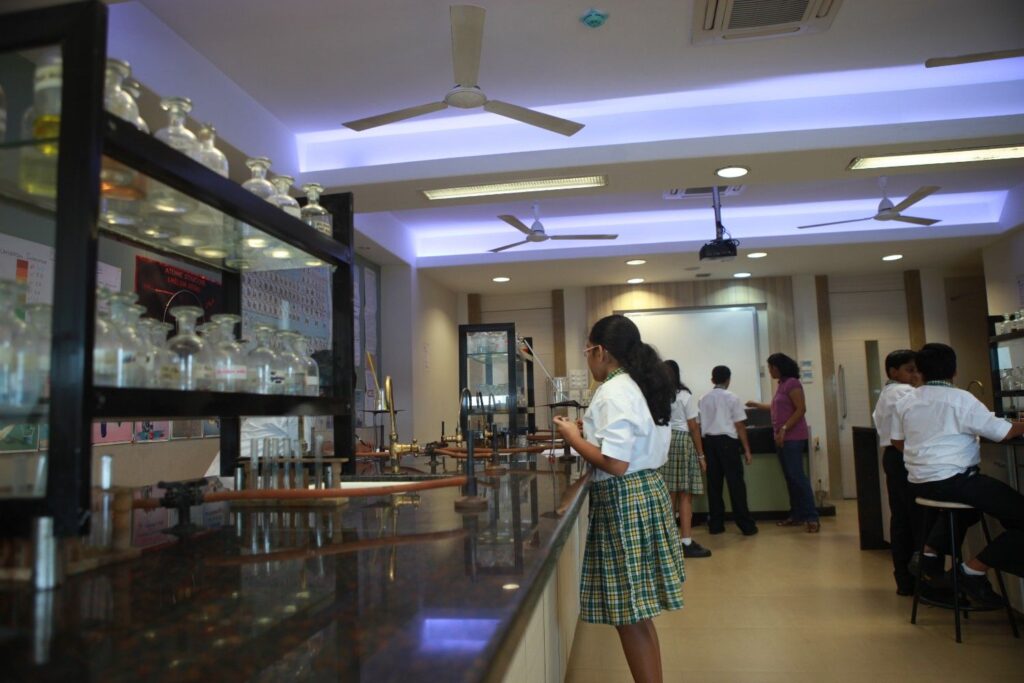
Parents often focus on curriculum first, but the physical and emotional environment of a school matters just as much. The Ministry of Education says a good school should make every student feel welcomed and cared for, with a safe, stimulating learning environment and the right resources to support growth.
Harvard’s research on developmental environments also shows that what surrounds children shapes how they develop, learn and respond to the world.In other words, school space is not background. It is part of the lesson.
Why Space is Part of the Learning Itself?
Children do not learn in a vacuum. They learn through what they see, touch,hear, and experience every day. The National Curriculum Framework for the Foundational Stage in India emphasises play-based learning, conversation, stories, toys, music, art and carefully organised classroom environments.
It also notes that content for young children should be sensorially engaging, rooted in familiar experiences and connected to their own world.That is why a classroom’s layout, rhythm, and mood are not small details.They shape attention, confidence and participation.
A child who feels calm in a room is more likely to explore. A child who feels seen is more likely to speak. A child who feels safe is more likely to try again after making a mistake. This is especially important in early years, when emotional security and curiosity are being built together.
NAEYC describes developmentally appropriate practice as a strengths-based,play-based approach to joyful, engaged learning, and that idea starts with the environment around the child.
What MBIS Mumbai Does Differently?
At MBIS Mumbai, the environment is built around a boutique learning model. The school describes this as smaller class sizes, personalised learning, differentiation techniques, and regular parent involvement. That matters because smaller settings make it easier for teachers to understand how each child learns, notice where support is needed and create a more responsive classroom culture.
The school also frames its learning atmosphere as stimulating and student-centric, not mass-produced. That distinction is important. In a large, impersonal environment, children can easily become passive. In a more focused setting, they are more likely to participate, ask questions, and build confidence through repeated interaction.
MBIS Mumbai positions this as part of its broader educational philosophy, where learning is shaped not only by teaching methods but by the space in which those methods happen.
This is where environment becomes pedagogy. A room with structure, warmth,and personal attention does more than look welcoming. It supports habits of curiosity, independence and reflection. Those habits become especially valuable as students grow and the academic demands become more complex.
How Environment Supports AS Level and A Level?
The impact of environment does not stop in the early years. It becomes even more visible in senior school, where students need room to think deeply and work independently. At MBIS, the Cambridge International AS & A Levels programme is described as tailored to learner needs, with an emphasis on in-depth knowledge, strong reasoning, contextual problem-solving, research and self-regulated learning. The school also says the programme supports global awareness, cultural sensitivity and all-round progress.
That is where the A Level curriculum benefits from a strong environment.Students at this stage are not just memorising information. They are analysing, debating, presenting, and making decisions about their future. A supportive school space helps those habits grow. MBIS says its boutique model provides a personalised environment where learners can focus on subjects, they are passionate about, engage in contextual scenarios and build the soft skills needed for an advancing world.
A strong environment also reduces one of the biggest risks in senior school:invisibility. When students are known well, they are easier to guide well.When they are guided well, they are more likely to stretch themselves with confidence. That is one reason a school’s physical and emotional design can shape outcomes just as much as the curriculum name on paper.
Final Thoughts
The most effective schools do not treat space as decoration. They treat it as part of the learning system. A safe, stimulating, responsive environment helps children build confidence early and independence later.
At MBIS Mumbai, the boutique model, the early learning atmosphere, and the Cambridge pathway all point to the same idea: young minds grow best when the space around them is designed to help them think, try and thrive.
