

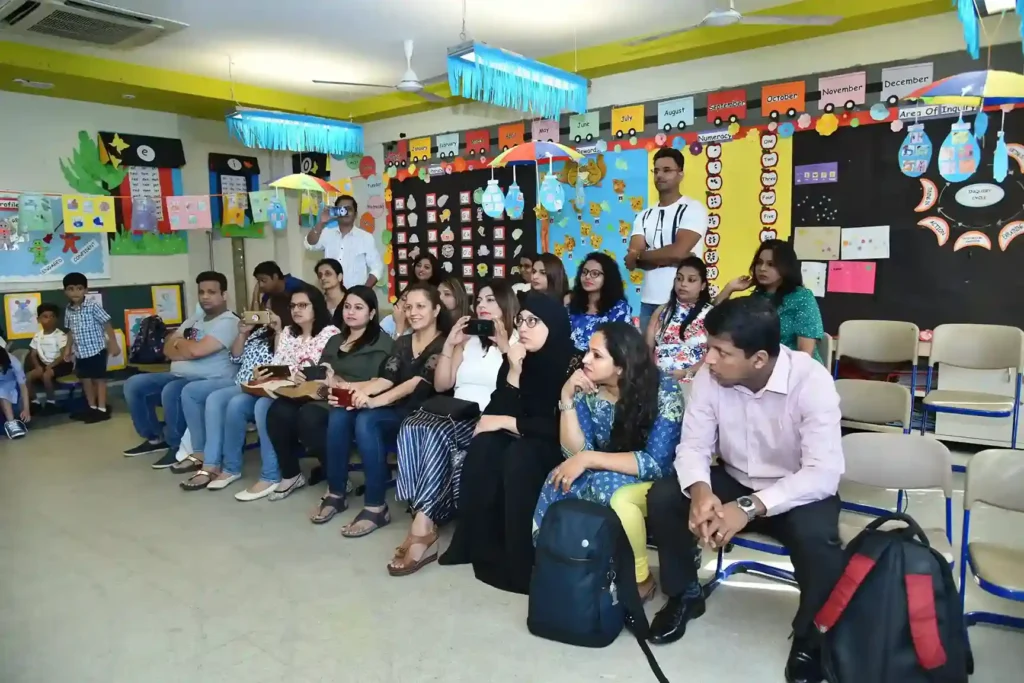
A school visit can tell you a lot about what a school has. It tells you much less about what a child actually experiences there.
You can compare classrooms, facilities, activities, timings and other practical details. But you cannot understand a learning environment simply by looking at it. The more revealing moments are often ordinary ones: what happens when a child asks an unexpected question, struggles with something or wants to try a different approach.
For a young child, the first school introduces more than letters, numbers and routines. It begins shaping how they participate in learning.
Start by Watching, Not Just Asking
During an admission visit, it is easy to focus on what adults tell you. Watch the children instead.
Are they merely following instructions, or are they talking, creating, experimenting and making choices? Does the teacher do most of the explaining, or do children have opportunities to contribute observations and ideas?
Cambridge International identifies active learning as one of the principles of its Early Years approach. It describes children as being actively involved in their learning and developing competence, agency and self-worth. Its approach also places play at the centre of Early Years learning, alongside child-initiated and adult-led activities.
That distinction matters. A classroom can be busy without children having much ownership of what they are doing. Look for evidence that children are participants in the learning rather than simply completing tasks.
Listen to What Happens After “Why?”
Young children ask questions constantly. A school’s approach becomes visible in what happens after those questions are asked.
Suppose a child asks why something happens. Does the teacher simply provide the answer and move on? Or does the question lead to another observation, discussion or investigation?
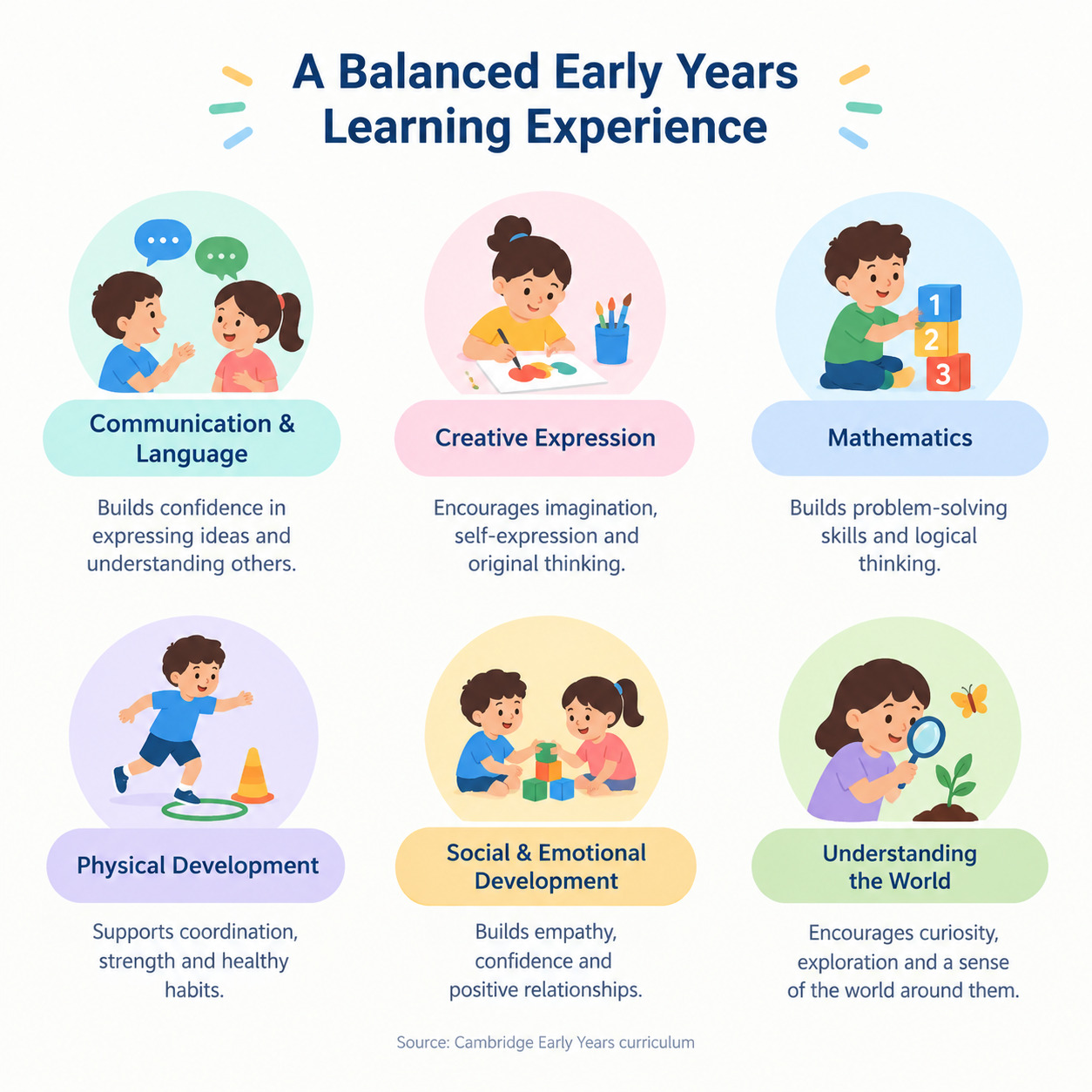
Cambridge International’s Early Years curriculum includes Understanding the World, which encourages children to explore and make sense of the world around them. The curriculum also includes communication and literacy, mathematics, creative expression, physical development, and personal, social and emotional development.
This gives parents a useful admission test. Ask teachers how they respond to unexpected questions. The answer can reveal whether curiosity is genuinely part of classroom learning or simply something children bring with them.
Watch What Happens When Something Goes Wrong
Independence is easiest to recognise when things do not go according to plan.
A child may struggle to complete a task, disagree with an idea or discover that their first attempt has not worked. Does an adult immediately step in and fix it? Or does the child receive appropriate guidance while still having an opportunity to try?
Independence in the Early Years is not about expecting children to solve everything alone. It can begin with small experiences of making choices, attempting tasks, expressing preferences and finding another way forward.
These moments matter because they show children that difficulty does not automatically mean an adult needs to take over. The right support can help a child become increasingly capable without removing the challenge altogether.
Ask What the Activities Are Actually Doing
An activity-filled timetable can look impressive during an admission process. But more activities do not necessarily mean better learning.
A story, creative task, outdoor experience, mathematical activity or conversation can each contribute differently to a child’s development. What matters is whether there is a reason behind the experience and whether children have meaningful opportunities to participate.
Instead of asking how many activities take place in a day, ask what children are developing through them. Are they communicating? Moving? Creating? Exploring? Building foundational skills? Learning to work with others?
This is a more useful way to think about balance. A balanced Early Years programme is not necessarily the busiest one. It is one in which different experiences serve meaningful purposes.
See How the Philosophy Appears at MBIS
At MBIS Mumbai, the Early Years Programme states that children are encouraged to explore, learn and grow at their own pace, with attention to individual needs and interests. The school describes its approach as combining storytelling, play-way, experiential and inquiry-based methods, with literacy, numeracy and inquiry as three core disciplines. It also states that its inquiry approach encourages children to ask questions, share ideas and analyse.
MBIS states that its Early Years classes are kept small, with two teachers and support staff assigned to each class. These details become more meaningful when considered alongside what parents observe in the classroom.
Do children have opportunities to participate? Are their questions taken seriously? When they encounter difficulty, are they supported without every challenge being solved for them?
Those are the moments in which an educational philosophy becomes visible.
The Question Worth Taking into the Admission Visit
Location, fees, timings, safety and facilities will always matter when choosing a first school. But they tell only part of the story.
A visit can reveal the rest if you know what to look for. Watch how teachers respond to questions. Notice whether children have opportunities to make choices. Pay attention to what happens when an attempt does not work. Ask how play, exploration, communication and foundational learning fit together.
Then ask the question that brings all of these observations together:
What will my child actually be doing, thinking and experiencing here every day?
The answer may tell you more about a first school than any brochure ever could.
FAQs
1. What should I observe during my child’s first school visit?
Look at how teachers interact with children, whether children actively participate, how questions are handled, how independence is encouraged and whether the classroom provides meaningful opportunities for play and exploration.
2. How can parents tell if an Early Years classroom is genuinely child-centred?
Look for children having age-appropriate opportunities to make choices, contribute ideas, explore and participate rather than simply following instructions throughout the day.
3. What questions should parents ask during an Early Years admission?
Ask how the school approaches play, inquiry, independence and classroom participation. It is also useful to ask what a typical day looks like and how teachers support children when they find something difficult.
4. Is starting academics early the most important consideration for a first school?
Not necessarily. Early Years education also involves communication, physical development, social and emotional development, exploration, creativity and play. The important consideration is how these different experiences work together.
