


Every parent celebrates a correct answer. But an even more important question is: How did your child arrive at that answer?
Children who ask thoughtful questions are doing more than seeking information. They are making connections, testing assumptions and learning how to think independently. When information is instantly available, knowing how to question it matters alongside knowing the answers.
For families exploring Cambridge schools in Mumbai, this reflects an important principle within Cambridge education. Cambridge International describes its learners as confident, reflective, innovative, responsible and engaged, with an emphasis on curiosity, intellectual risk-taking, exploring ideas and digging more deeply.
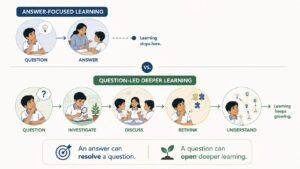
Questions Turn Information into Understanding
Knowing an answer and understanding it are not the same thing.
A child may remember that plants need sunlight, but asking why some plants grow in the shade demonstrates a different level of thinking. The question opens a path towards comparison, investigation and evidence rather than ending at recall.
Cambridge International’s guidance on developing its learner attributes specifically identifies questioning as a way to make student thinking visible. It notes that asking learners to formulate their own questions can develop curiosity, stimulate deeper thinking, encourage different perspectives and help them plan investigations. This makes questioning more than a participation technique. It also helps teachers understand how children are thinking and where learning needs to go next.
This is where classroom communication becomes essential. When students can ask questions and explain their reasoning, learning becomes a dialogue rather than a one-way transfer of information. Students listen to different viewpoints, reconsider their assumptions and refine their understanding through discussion.
Asking Questions Builds Intellectual Confidence
Many parents believe confidence comes after children know the correct answer. In reality, intellectual confidence can begin earlier, when children realise they are allowed to explore an idea before they have completely figured it out.
A classroom that welcomes thoughtful questions gives students permission to say, “I am not sure, but I think…” It allows teachers to see misconceptions, classmates to contribute alternative perspectives and students to discover that uncertainty can be part of learning.
India’s National Education Policy 2020 similarly places emphasis on conceptual understanding rather than rote learning, alongside creativity, critical thinking and problem-solving. These priorities point towards an education in which students use information thoughtfully, not merely remember it.
Exploration Helps Children Learn How to Think
Children are naturally curious. They ask why seasons change, why the sky changes colour and why people experience the world differently. A classroom protects that curiosity instead of replacing it with the pressure to produce an immediate correct response.
Rather than treating questions as interruptions, discussion-led exploration can use them to begin investigations, collaborative learning and meaningful conversations. Students can learn to observe carefully, gather evidence, challenge assumptions and refine their thinking. The value lies not simply in remembering more information, but in becoming better equipped to apply what they know to unfamiliar situations.
For parents exploring schools across Mumbai, including Cambridge schools in Goregaon and Malad, it is worth looking beyond academic results and asking how classrooms encourage exploration. Does a teacher ask students to explain how they reached an answer? Are follow-up questions welcomed? Do students have opportunities to investigate before receiving an explanation?
Curiosity Needs Support at Home Too
Children rarely stop asking questions because curiosity disappears. Often, they learn that some questions are inconvenient or not worth asking.
Parents can protect that curiosity through small changes in everyday conversations. Instead of immediately providing an answer, try asking, “What do you think?” or “How could we find out together?” Such prompts encourage children to reason, investigate and become more comfortable with uncertainty.
When schools and parents value curiosity together, children begin to understand that learning is not about avoiding mistakes or appearing certain. It is about developing the confidence to keep exploring.
Why It Matters for the Future?
The ability to think independently, communicate clearly and adapt to unfamiliar situations does not begin with a career choice. It develops through repeated opportunities to question, investigate and reflect.
At MBIS Mumbai, this philosophy is reflected through exploration-based classroom experiences that connect learning with the real world. During the Senior KG Inquiry Fair on Communication, students explored how signs and symbols shape everyday life through observation, discussion and collaborative exploration. They were encouraged to observe, interpret, explain and communicate their understanding rather than simply memorise information.
For parents evaluating Cambridge schools in Mumbai, one question is worth asking before choosing a school: Does the classroom only celebrate children who know the answers, or does it create opportunities for children to investigate, question and think independently?
The best education does not make the right answer less important. It makes the journey towards understanding more meaningful. Because the questions children learn to ask can shape not only what they know, but how they learn to think.
FAQs
1. Why is the importance of asking questions emphasised in modern education?
Questions encourage students to think critically, understand concepts more deeply and participate actively instead of relying only on memorisation.
2. How does classroom communication improve learning?
Strong classroom communication allows students to exchange ideas, ask thoughtful questions, learn from different perspectives and build confidence through everyday participation.
3. Why do Cambridge schools in Mumbai place so much emphasis on asking questions?
Many Cambridge schools in Mumbai encourage question-driven learning because questioning helps students analyse information, connect ideas and develop deeper understanding. Instead of memorising answers alone, students learn how to investigate concepts, explain their thinking and approach problems from different perspectives.
4. How can parents encourage children to ask more questions?
Parents can encourage curiosity by listening patiently, appreciating every question and responding with prompts that inspire children to investigate, explore and discover answers independently.
