

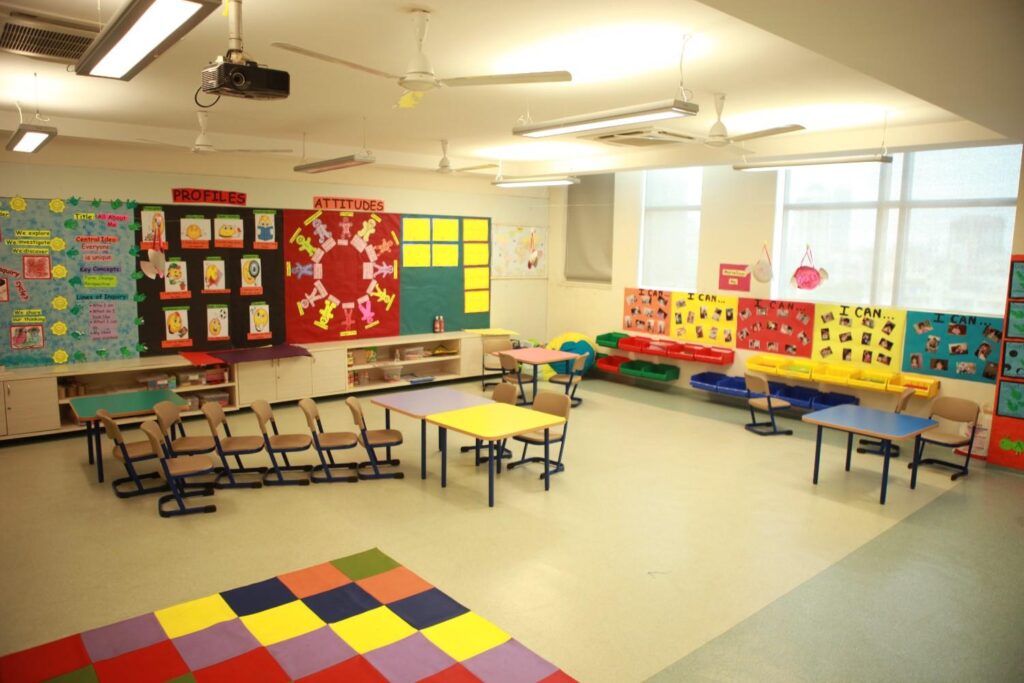
A classroom can be physically secure, academically rigorous and well-equipped, yet still leave a child hesitant to speak.
That hesitation matters because learning requires children to expose unfinished thinking. They may need to say, “I don’t understand,” ask an unexpected question, test an idea or admit that their first answer was wrong. If those moments feel embarrassing, silence can become easier than participation.
For parents evaluating a Cambridge school in Mumbai, this is an important distinction. A classroom should make it safe to use, question and revise that knowledge.
Safety Has More Than One Dimension
Physical safety is foundational, but learning also depends on what happens between people.
Emotional and interpersonal safety means students feel respected by teachers and peers. Psychological safety in schools goes a step further: children feel able to take the interpersonal risks that learning requires, such as asking for help, sharing an incomplete thought or making a mistake.
That does not mean removing challenge. It means a child can be challenged without feeling personally diminished. A teacher can say, “Let’s look at that another way,” while still communicating that the child’s thinking is worth exploring.
Why Psychological Safety Changes Participation?
A 2026 mixed-methods study of upper-secondary classrooms found that supportive teachers and respectful peers made students more comfortable speaking, while fear of public evaluation could discourage participation. The study focused on older students, but it illustrates an important principle: classroom relationships influence whether students feel comfortable taking intellectual risks.
The National Education Policy 2020 also emphasises critical thinking, discussion, creativity and active participation rather than relying only on rote learning. For schools, the implication is straightforward: active participation requires a classroom where participation feels respectful and worthwhile.
Questions Reveal How Children Are Thinking
The importance of asking questions goes beyond curiosity. Questions can reveal what children understand, where confusion remains and what they are ready to explore next.
Compare two classrooms. In one, students listen for the correct answer. In another, they are encouraged to ask why something works, whether another explanation is possible and how an idea connects to something they already know.
Both may cover the same syllabus. The second gives students more ownership of learning.
This is where classroom communication becomes central. A teacher who asks, “What makes you think that?” turns an answer into a conversation. Allowing thinking time before responding signals that an unfinished idea is worth hearing. When students can disagree respectfully, discussion becomes part of learning rather than a performance of who is right.
What Creates a Positive Classroom Environment?
A positive classroom environment is not one where children are constantly praised or where lessons are always easy. It is one where expectations are clear, relationships are respectful and mistakes can be examined without humiliation.
Parents visiting a school can look for signs such as:
- Does the teacher allow thinking time after asking a question?
- Does an unexpected answer trigger curiosity before correction?
- Can students disagree without ridiculing one another?
- Are quieter students given opportunities to contribute?
- Do students explain their reasoning rather than only provide answers?
These details reveal whether children are participating.
How MBIS Mumbai Brings Inquiry into Learning?
At MBIS Mumbai, inquiry is part of the school’s stated learning approach. Its Primary Programme says students are encouraged to think for themselves, frame relevant questions, conduct research and develop problem-solving skills, with Inquiry Fairs providing opportunities to articulate understanding.
A relevant example is the Senior KG Inquiry Fair on Communication. Students visited a Traffic Park to observe road signs, traffic lights and zebra crossings before exploring signs and symbols further at school. The classroom was transformed into a mini signs-and-symbols park, where students explained different forms of communication to their parents.
The point is not the activity itself. Students had to observe, interpret and communicate what they understood. In our reading of the activity, that makes the connection to psychological safety relevant: inquiry asks children to make their thinking visible and that becomes easier when they have room to share, question and reconsider ideas without embarrassment.
Why It Matters Beyond School?
Children will eventually face unfamiliar problems and decisions where there is no teacher waiting with the correct answer. They will need to ask questions, communicate clearly, reconsider assumptions and learn from mistakes.
For parents evaluating a Cambridge school in Mumbai, one of the most revealing questions is whether children can comfortably say, “I don’t know yet,” “I think differently” or “Can you explain that again?”
A classroom feels safe enough for children to learn when they do not have to protect the image of always being right. They can expose unfinished thinking, receive guidance, rethink an idea and try again. That is not comfort replacing rigour. It is the environment that allows rigour to work.
FAQs
1. What is a safe learning environment?
A safe learning environment is one where students feel physically and emotionally secure enough to participate, express ideas, ask questions and learn from mistakes without fear of humiliation.
2. Why is classroom communication important?
Classroom communication allows students to explain their thinking, listen to different viewpoints, ask questions and participate actively while helping teachers understand how students are processing what they learn.
3. What is psychological safety in schools?
Psychological safety in schools means students feel comfortable expressing ideas, admitting uncertainty, asking for help and making mistakes without fear of ridicule or unnecessary judgement.
4. How can parents identify a psychologically safe classroom?
Parents can observe whether students ask questions naturally, whether teachers allow thinking time, how mistakes are handled and whether students can express different viewpoints respectfully.
5. Why is the importance of asking questions significant for children?
The importance of asking questions lies in how questions encourage curiosity, critical thinking and deeper understanding, helping children move beyond memorisation towards investigation and independent thinking.
